Tristia
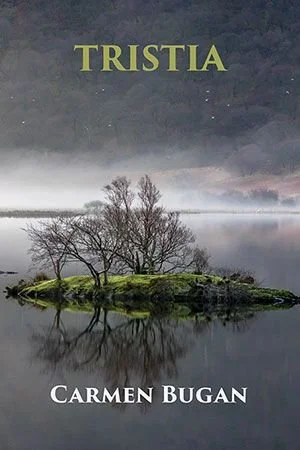
Tristia, by Carmen Bugan. Bristol, United Kingdom: Shearsman Books, 2025. 88 pp. £10.95 / $18 (paperback)
The trusty New Oxford Shorter English Dictionary defines “triste” as “sad, melancholy; causing or expressing sorrow; lamentable” and while the poems in Carmen Bugan’s sixth collection have all these qualities, they also contain a good deal of consolatory power in response to marital breakdown, the death of loved ones and the insecurities of our current political moment. So, while Tristia is full of sorrows, its elegiac note meets the challenge outlined by Michael Ignatieff in his persuasive book On Consolation (2021), “to accept [our] losses, to accept what they have done to us and to believe, despite everything, that they need not haunt our future or blight our remaining possibilities” (p. 7). As the blurb to Tristia informs us, in this sense, “Carmen Bugan tests the lyric against loss [while also] forging a stronger self in the fires of her lifetime . . .” and in doing so, she demonstrates that poems about sad things in sad times can be uplifting by giving voice to human resilience.
We can get a flavor of Bugan’s tristesse from a brief sampling of her collection’s most characteristic poems. In “Holy Communion,” the poet reflectively “walk[s] alone to the room [she] filled with flowers / Nearly seventeen years ago, preparing / For [her] wedding”; but now, the same room serves to remind the poet of her subsequent losses, of her “dying / Father, lost marriage . . .” even as the memory of “those August roses” provides some contrastive balance (p. 54). A sequence titled “Pictured Rocks, July 2022” invokes a personal bedrock, “the backbone of endurance” needed in times of adversity (p. 41). Often in these poems, birds — herons, ospreys, cormorants — provide solace, suggestive of the constancy of natural cycles when the poet’s personal world seems to have been wrenched from its axis. So, the “free and fearless” golden eagles “looking down at us” in “The Miners’ Castle” (third poem in the “Pictured Rocks” sequence) provide a moment of consolatory “power” (p. 39). Elsewhere, birds and nature in general have a “soothing music” and glimpses of nature’s bounty serve as brief counterpoints to unlucky personal and professional circumstances; a “lone white pine” somehow growing out of “sandstone” may even provide “proof of miracles,” and of survival in “Chapel Rock” (p. 38).
In some of these poems, the dead weight of dejection slows their rhythm in expressive linguistic sympathy with the de-energized self:
The sun stood still,
The light in the house was weak,
So much like this time of my life,
When luck stands still.
(“Solstitium,” p. 55)
and we notice here how each line is separated by a comma which, on grammatical grounds alone, do not seem strictly necessary. One feels, as these following lines also imply, that the poet is clipping her own poetic wings to convey her sadness and sense of failure:
Here in the verdant garden turned to weeds
They have clipped my wings, past the middle
Of my life, after I have earned the right to fly.
(“Bird Lament,” p. 64)
And if the seasonal imagery is familiar, and worn, Bugan’s poems win us over, in the main, by their honesty and candor. Their expressions of “hopelessness” (“Whatever Happens,” p. 31) remind us that finding reasons and ways to go on living is, in Michael Ignatieff’s words “the most arduous but also the most rewarding work we do” and this undertaking is a precondition of renewing our sense of hope (On Consolation, p. 257). A “reckoning . . . with loss and failure” comes first (p. 257) and Bugan’s collection as a whole enacts a dark season of the soul — tracked by compositional dates throughout the volume — as a prelude to a much-needed renewal of self.
This Dublin-based reviewer could not help but notice an important Yeatsian intertext which surfaces more than once in Tristia. The Irish Nobel laureate famously takes cognizance of aging and life’s reversals in “The Wild Swans at Coole” where the emblematic presence of the swans — “those brilliant creatures” — provides solace and an example of endurance, “Their hearts have not grown old.” Bugan’s conscious allusion to her melancholy mid-life mood via Yeats is evident in several places: in “Farewell West Meadow” where “Swans take off the pond”: with “Clamorous, water-bearing wings” (p. 80); in “Easter 2023” where “The Christian spirit rises on great wings” (p. 66) and again, arguably, in “Hawk” where the bird is “An apparition with great wings” (p. 78), seemingly “Mysterious” and “beautiful” as the Coole swans appear in stanza five of that 1917 poem. Thus Bugan deliberately echoes the eruptive and epiphanic moment in Yeats where his “nine-and-fifty swans . . . // scatter wheeling in great broken rings / Upon their clamorous wings” over Coole demesne, a momentary breaking away, surely, from the boundaries of the human self and daily troubles.
Of course, the original Tristia was composed by Ovid in 8AD following banishment — or relegatio — by Emperor Augustus from Rome to Tomis, on the Black Sea coast, modern-day Constanța in Romania which is Bugan’s country of origin. And Bugan’s exilic consciousness, which has been a significant influence on her poetic and personal identity, leaves its mark on many of these poems. There are several departures and journeys represented as breaking points for the family members involved. In “La Cinquantaine — Gabriel Marie,” the poet’s son playing the cello in—the family’s unhappy household — “the liquid / Trill of inner crying” — prompts the poet to see the broken song of their current lives as reason enough “to start a life anew” (p. 13). Indeed, the book’s opening poem is titled “Leaving”:
We will leave behind those we love,
Saddened by how little time
We were granted with them.
(“Leaving,” p. 9)
and the book concludes also with a poem of rupture and new beginnings. Like Ovid, the contemporary poet has “travelled across the map” with her two children, but she only “discover[s] there is still / A long journey ahead” (“Sandhill Cranes,” p. 84). Renewal is not a foregone conclusion and the book ends equivocally “With feelings that cling, / And call us back” (p. 84).
Nevertheless, the trope of the journey, the setting forth and the looking back, is a dominant feature of these poems. For example, in response to her father’s illness, the poet traverses space and time with urgency, “flying North-West” to be with him even though, fortunately, “It’s not time / Yet for [his] crossing” (“Your Time,” p. 51-2). Another journey takes the poet in an easterly direction to Abu Dhabi, to exile of a kind in a region of “White hot sand” (“White Sand,” p. 72). A “journey of returning” is one that the poet’s father ultimately makes, being laid to rest at “Vatra Monastery in Michigan” (“Momento Mori,” p. 57) and the concept of the good death, of being reconciled to “the ending of it all” (On Consolation, p. 245), best characterizes Bugan’s poems of love and farewell to her father in this volume. We are given glimpses of a dignified “Peace” achieved before his death (“Holy Communion,” p. 54), but also, in the aftermath, a certain hopefulness:
It’s May again, the grave is green and healed,
The cemetery trees are filled with birdsong . . . //
And now I wonder if it’s peaceful
Where you are, if you hear the noise of time.
(“Since You Died, the Earth Turned Green,” p. 67)
In the background here are the many hardships of Bugan’s family background, including her father’s imprisonment as a political dissident in Ceaușescu’s Romania. These harrowing experiences feature more extensively in Bugan’s earlier collections: Crossing the Carpathians (2004) and Releasing the Porcelain Birds (2016) as well as in her memoir of growing up in Cold War Romania, Burying the Typewriter: Childhood Under the Eye of the Secret Police (2012). What emerges in these latest poems about her father’s last months is the immense dignity of his life and the ending of it even though his sufferings as a political prisoner are not dwelt on in Tristia.
If Bugan’s latest collection is heavily freighted with the slings and arrows which life invariably casts at us, it achieves a certain equipoise, if not occasional serenity, by seeking out healing moments amidst “the noise of time” (p. 67). Moments of bitterness — “Our marriage is no more” (“Sea, Wind, Moon,” p. 63) — vie with moments of plenitude, “Today we bring our love for your new, tender world” (Wedding in Riga,” p. 70). Occasional sweetness — the epithalamium for her brother’s wedding, for example, is heavily saccharine — allows a “once happy house” (“Ray of Sunlight,” p. 59) to be reflected back into the more sombre general timbre of Tristia with a variegated balance of moods thus emerging. And, as with her previous collection Time Being (2022), one feels intensely the happenstance of what may or may not happen in the future, an uncertainty which, in the very fine final poem of that 2022 collection, “The hook,” is seen ultimately as “unknowing” and “Unknowable” (Time Being, p. 97).
—Reviewer Ben Keatinge is a poet and critic from Dublin. His debut pamphlet Waiting for Goran at the Broz Café: A Balkan Sequence was selected for the Ireland Chair of Poetry pamphlet series in 2024 and is published by HOWL New Irish Writing.