Kafka’s Ax
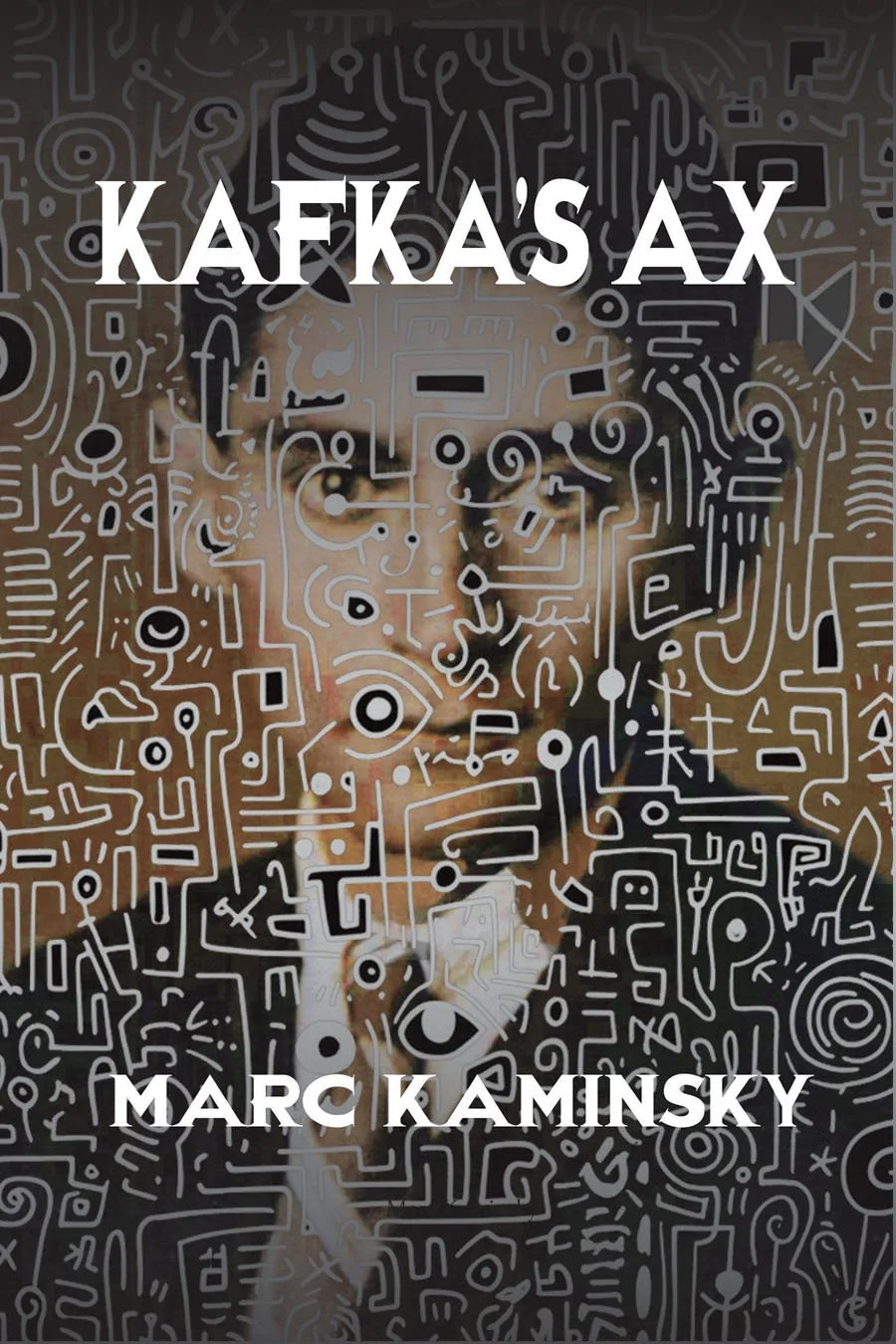
Kafka's Ax by Marc Kaminsky. Dos Madres, 2025, 265pp. $27 (paper)
Drawing on the writings of Franz Kafka as well as on a spectrum of biographical, epistolary, and documentary sources, Marc Kaminsky offers a hybrid collection of poetry, prose, and commentary as voiced by a cast of factual and fictional characters who had been—or could have been—within the orbit of the troubled writer's life and work. As a poet, psychotherapist, and student of Yiddish culture, Kaminsky is well-equipped to explore and reimagine Kafka's lives (inner and outer) and legacy from multiple perspectives. In a diary entry Kafka once wrote "My preoccupation with portraying my dreamlike inner life has relegated everything else to a secondary position," so he may have looked upon of Kaminsky's project with surprise (or possibly chagrin, given his modest nature) to see how one's inner life need not be limited to the psychological labyrinths of oneself alone but could assume separate, protean afterlives in the imaginations of others.
Kaminsky takes his title from a frequently quoted remark contained in a passage Kafka wrote in a letter to his friend Oskar Pollak: "What we need are books that hit us like a most painful misfortune, like the death of someone we loved more than we love ourselves, that make us feel as though we had been banished to the woods, far from any human presence, like suicide. A book must be the axe for the frozen sea within us." Much has been written about that last sentence, and interpretations vary among scholars, but the symbolic value of the axe as a tool of disruption and division is especially apt here. For Kafka, the separation of his inner, writing life from his life in the external world of work, love, and family was an obsession. Though the author was unfulfilled (albeit for different reasons) in both, Kaminsky takes pains to show that he was fully engaged whether "running around in his own labyrinth" or diligently poring over the technicalities of occupational safety standards as an insurance claims agent. Every border is porous, though, and Kaminsky supplies ample evidence that each of Kafka's irreconcilable lives informed the other in both subtle and not-so-subtle ways.
Kafka's Ax is arranged in seven sections addressing various aspects of Kafka's relationship to the world, such as: his life-defining conflict with the father ""who never stopped taking inventory of his son's faults" and his ambivalence toward his father's expectations; his discovery and recovery of his repressed Jewish identity via his exposure to Yiddish theater; his obsessive dedication to writing at the expense of marital companionship; and the ways in which his psychological and emotional conflicts took imaginative form in his fiction as manifested through papers delivered at a fictional conference of literature scholars.
Lest any of this sound too academic or hermetically focused on biographical and literary minutiae to engage those less enthralled by this most enigmatic of modernist writers, rest assured that Kaminsky unravels a narrative as engrossing as any dramatic or true crime podcast. Through a series of introductory poems we meet Kafka the flâneur, wandering the medieval streets of Prague, which Kafka biographer Ernst Pawel aptly dubbed the "citadel of lost causes," registering the urban activity around him while at the same time longing for the relative security and seclusion of his small room, the physical center of his creative life—
Sitting at the desk over the white
page, he converts the narrow room
into the strait gate
through which he meets the gaze
that at every moment writes the Last
Judgment of the life
he fails to live outside his room. ("His Room")
—as well as the portal to the vast, imaginative multiverse it enabled him to conjure:
Every person is given a room where
he may remain faithful
to what he desires. For me,
it's the bedroom where
I dream subterranean corridors,
spiraling staircases, roads buried
in snow, deserts, trackless
wastes over which I go on
sending determined messages. ("Toward Dawn")
No idle dreamer, Kafka was cursed (or blessed) with "a demand that he travel / in the dark between contradictions, an / expense of spirit, lusting after / the impossible..." ("The Black Letters"). Alone with himself, closeted from the demands of his father and the family business, Kafka was able to achieve a "hypnoidal state," defined by Kaminsky via a "paper" presented by a fictional psychiatrist as "the gray zone in which consciousness drifts between waking and sleeping...this floating of the mind in which [Kafka] crossed over between worlds." Such crossings were essential if he were able to make any sense of his bisected life, each side of which reflected the impossibility of living the other.
While Kafka wrote little poetry besides that which appeared sporadically in letters, Kaminsky does a convincing job of emulating Kafka's plainspoken candor and lyric economy as it would likely be rendered in English. Equal to that are his renditions of Max Brod detailing the specifics of his close friend's home life and Franz's desire to leave Prague: "to him, all of Prague was a tightrope stretched between two extremes, with no middle." Still, "he tracked his failure to do the impossible, and turned his ongoing defeat in Prague to the advantage of the artist." While applying the lemons-into-lemonade analogy seems trite in the context of Kafka's artistic and personal tribulations, it's apt, and the reading world might not have inherited such harrowing masterpieces such as The Castle, Metamorphosis, The Trial, etc., if their author had led a more stable, "normal" life.
In the poem "In Search of a Master," written in Kafka's persona, he tells us:
I have dwelt completely in every idea,
but also filled every idea, and not only felt myself
at my boundary, but at the boundary of the human...
While living at "the boundary of the human" may serve as a self-sacrificing, romantically stated goal for any writer's or artist's emotional life (cf. Taylor Swift's The Tortured Poets Department), for Kafka it defines the precarious tightrope of living noted above. For all his diligence and dedication to the writing life, it seems Kafka was never entirely satisfied with the result. There was always some elusive quality that remained unattainable. Similarly, his desire for a life of love, marriage, and family was thwarted by the commitment to be an artist at all costs. Kaminsky (writing as Brod) observes, "Franz wished to be numbered among ordinary men, but the demands of the art he practiced were absolute." ("In His Father's Warehouse"). Contrary to the popular image of a brooding, insular, tormented Kafka, there was no shortage of lovers and soul mates in his life—Felice Bauer, Dora Diamant, and (perhaps most passionately) Milena Jesenská—but as Kaminsky in the guise of Kafka writes, "if I were to lie / side by side in bed / with a wife, I'd be / totally hemmed in" ("In Bed"). In fact, Kafka viewed even a relative degree of comfort—many German-speaking Jewish families of Prague were bourgeoisie—as a distraction and thus a threat to his writing: "The work awaiting him is tremendous, it can't be / done as long as he lives / under comfort's constant harassment." ("His Futility").
In the effort to navigate Kafka's labyrinthine life and consciousness, Kaminsky offers imagined conference papers and other prose pieces of speculative biography, hypothetical memoir, and literary criticism to supplement his poems. The faux conference presentations (e.g., "The Investigator Makes His Report: On Kafka's Prose," "The Wounded Body: Myth and Reality in Kafka's Work," "The Relationship of Prayer" by "Rabbi I.B. Bryk") might pass for real academic papers if not for their readability. Kaminsky's presenters avoid the gnarly, gnostic vocabulary and abstractions of literary theorists and psychologists, favoring instead the traditional tools of practical analysis, presenting hypotheses and supporting them with evidence from primary sources. To establish the atmosphere of a real conference, Kaminsky even includes some housekeeping announcements regarding changes in the program and weather advisories, sometimes to lightly comic effect ("Conditions out there have got a lot worse over the past two hours, but there's no reason for anyone to leave the building. We've catered a hot kosher lunch for you in the lobby.").
Perhaps the most intriguing piece in Kafka"s Ax is "The Kafkan Sentence," a kind of multi-dimensional memoir that explores one of the less documented aspects of the writer’s life, his relationship with Dora Diamont and the time the pair spent together in a small, unheated (because they couldn't pay the bills) Berlin apartment, studying the Torah in Hebrew and dreaming of a life together in Jerusalem or Tel Aviv while Kafka, persisted in his writing despite his rapidly deteriorating health. Here Kaminsky introduces the character of "Adrienne Gottbaum," a Kafka devotee seeking to explore the writer's engagement with Yiddish theater by tracking down and interviewing residents of Jewish nursing homes who might recollect Yitzhak Levi, a prominent director and actor who became Virgil to Kafka's Dante in his exploration of the observant Jewish lifestyle his own family had all but erased from their home. Now an eponymous character in the Kafka saga, Kaminsky records his periodic meetings with Gottbaum and the revelations she gleans from those who knew Diamont, including the prospect of a lost short story. This complex piece vividly imagines Kafka's rigorous revision process: "He was quick to see his defects. He would write a sentence and immediately cross it out. A misplaced comma, a sentence with too much or too little in it — it stopped him cold." Within the context of Gottbaum's pursuit, the memoir also includes an analysis of Kafka's last story, "The Burrow," as well as the reconstruction of a play, "Story of the Woodcutter," based on an apocryphal short story by Kafka.
Certainly, scholars and devotees of Franz Kafka will find much to enjoy (and likely dispute) in Kaminsky's uniquely faceted approach to his enigmatic subject, but one need not be immersed in Kafka scholarship to recognize the author's skill in restoring animation and intimacy to a literary icon whose life and work has been analyzed and dissected in thousands of books, articles, and dissertations for nearly a century. In casting light from a new, imaginative sun, Kaminsky shows us that Franz Kafka—as deeply and complexly human as a writer can be—was far more than meets the myth.
—Reviewer Fred Muratori has published three collections of poetry, the latest being A Civilization from Dos Madres Press. His work has appeared in Poetry, The Iowa Review, Poetry Northwest, Redivider, The Boston Review, Barrow Street and elsewhere.