History of the Child
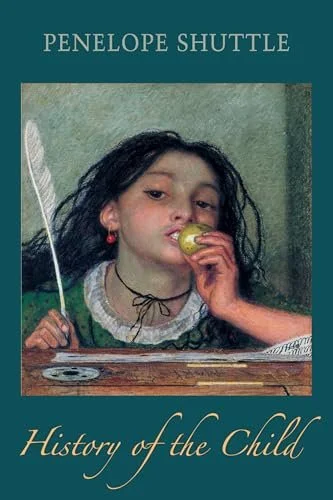
History of the Child by Penelope Shuttle. Hexham, Northumberland, UK: Bloodaxe Books, 2026, 125 pp. $20.00 (paperback).
In our time of unravelment—when the digital world threatens to undo everything else—Penelope Shuttle can gather the scattered strands of our lives in poems that are at once conversational and utterly, unpredictably poetic. That is, their formal beauty and emotional charge go hand in hand. In this age of soundbite jargon, metaphor still comes as naturally to Shuttle as English does. Her poems are musical, too, with the music always at the heart of her language, never mere adornment, often pointing the way forward.
In the longest section of this new collection, Shuttle takes us back into childhood with her. What happens when someone who admits to being "clumsy as a cowbell" as a child remembers the most reckless act of those days? Shuttle tells us in the poem "child's childhood.” (We shouldn't assume that the speaker in a poem is the writer, but here Shuttle has told us it is.)
the craziest thing the child ever did
was to swallow one pearl from the broken necklace
it clattered down her throat for years
it raked her insides with light
so much shine
it made her fall down like a cellar door
what a clang
How does one recover from that?
she gathered herself up like a lodestar,
she did,
like star-craft . . .
the crayon house plucking her to her feet
with its blood-red story of the plunging hawk
made of so many words
it could never end (83)
Notice that the child's drawing of a house, described in the poem's first stanza, is in league with both the world of stories and the world of nature ("the plunging hawk"). That mixture of nature and the imagination is indeed a bottomless brew: what could be more inexhaustible than all the fears and wishes of humanity that stories tell us about and nature, with its fireflies and galaxies?
Penelope Shuttle was born in Staines, Middlesex in 1947. She started writing early, publishing a novella when she was only 20. Her first poetic models were the British-born U.S. writer Denise Levertov and foreign poets that she read in translation: Rilke, Lorca, and Akhmatova.
At 23 she married Peter Redgrove, who, at 39, was a major voice in British poetry. The couple settled on the coast of Cornwall—the westernmost county in England—where they spent 33 years living and working together, writing poems deeply rooted in the natural world and, in later years, embracing ideas drawn from Jungian psychology. Shuttle also continued to write fiction, and, in collaboration with Redgrove, published a collection of poems, two other novels, and two additional books: The Wise Wound and Alchemy for Women.
After Redgrove’s death in 2003, Shuttle wrote a series of poems about their relationship that appeared in her 2006 collection, Redgrove’s Wife (see The Manhattan Review, Vol, 12, no. 2); that book was shortlisted for two of Britain's most prestigious poetry awards: the T.S. Eliot Prize and the Forward Prize.
Since then, she has published Unsent: New and Selected Poems 1980-2012 (Bloodaxe Books, 2012), two more Bloodaxe collections, Will You Walk a Little Faster? (2017) (see The Manhattan Review, Vol. 18, no. 2) and Lyonesse (2021), and, in collaboration with John Greening, Heath (2016), a sequence of poems about Hounslow Heath, a nature preserve on the outskirts of London, published by Nine Arches Press.
This new collection has four sections: "Father Lear,” whose subjects include historical figures ranging from Katherine of Aragon to Wallace Stevens; "Book of Lullabies,” a series of meditations on the past and the present; "History of the Child,” an evocation of Shuttle's childhood; and "little table,” a playful sequence inspired by memories of the poet's mother.
Part of the appeal of Shuttle's verse is the sense we often get of joining her in the experiences from which the poems emerge. In "Big Ships,” which has the immediacy of a diary entry, we follow the poet into the backyard, late at night:
If the sky's cloudy and the four winds blow
the night hastes about everywhere
doubting itself making me think
how sadness can bed-down in a heart
and on those nights
what a long time before I go back in the house
before I buckle the armor of sleep
around me (17)
Another attraction is Shuttle's constant search for new ways of approaching our world and ourselves. The poem “weather in its infancy” is a collection of more than two dozen aphorisms, including these three:
time is the snail
nibbling away
at the leaf of the heart (56)
November
with a dusting of summer gold
tangled in her hair (57)
god polishes
his best boots
for the funeral
of the earth (58)
The poems of the "History of the Child" section are especially good, and together the 37 poems have a cumulative power. The poem "sleeping rough in class" reminds us that the minds of our children seldom stay in the classrooms where we make them sit:
was the child a scholar?
she had lunar logic that's for sure
she had purpose enough for learning
but you'd have to catch her
in flagrante bello to find out
what knowledge meant to her
and why she never did homework
too busy inventing libraries
unearthing alphabets from outer space (95)
Yet, for all these flights of fantasy, Shuttle's childhood is often lonely. There are adults—her mother, an aunt, Uncle Dick, a math teacher, and Mrs. Rockefeller, a neighbor—but no father is named or appears, nor any other children, either siblings, cousins, or classmates. No wonder the child in "child as linden shield" feels "ignored by/her fellow beasts" (101). But, in "frequent subject of Japanese art," she feels a kinship with a figure in an artwork—or is that figure the child herself?
she's on the loose up in the air
with only Mount Fuji to protect her
she's there all cloud-summer
way beyond Yoshidaguchi they'll never find her
she's light and lovely as Gawain's lace collar
she doesn't miss her fourteenth-century mother a bit (96)
At this point in the child's history, we're pleased that she has at last found a place of contentment, though there are a few questions left to wrestle with before the history is complete, including "is the world real?" in "FAQ" (100) and "what is happiness?" in the poem of that title (110).
I think many readers will, like me, be equally pleased that the child who fled into the skies eventually decided to rejoin us here on Earth: Penelope Shuttle's poetry has been one of the delights of recent writing in English, and it's good to have this new collection from her.
You can listen to Penelope Shuttle reading "child's childhood,” accompanied by an animated film by Cat Brace, here: https://magmapoetry.com/the-childs-childhood
Reviewer Frank Beck is a writer and translator. With Raleigh Whitinger, he translated Anneliese’s House, a novel by Lou Andreas-Salomé (Boydell and Brewer). His website is www.diehoren.com.