Where the Sun Sleeps at Night: Folk Poems
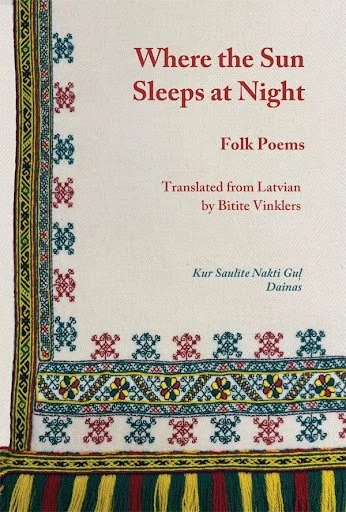
Where the Sun Sleeps at Night: Folk Poems. Translated from Latvian by Bitite Vinklers. Woodstock, NY: Mayapple Press, 2026, 81 pp. $20.95 (paperback)
Review by Jeanne Marie Beaumont
Bitite Vinklers, who has translated a half dozen distinguished poetry collections from Latvian (I had the opportunity to review the first of these for The Manhattan Review a decade ago), has here turned her knowledge and skill to translating a collection of Latvian folk songs, called the dainas. These essential pieces of Latvian culture have been rarely translated into English for reasons that Vinklers explains in her helpful introduction. She also informs us that “the dainas were handed down, orally, primarily by women, over many generations….” (p. 5) Perhaps for that reason we find a reversal of cosmic gender alliance from the one we may be accustomed to from other mythologies and folklore; in the dainas the sun is female while the moon is male—only one of the surprises that await the reader of these engaging poems. There is, however, also a pre-Christian male God, who like a family patriarch, enters a room and takes “his place / At the head of the table” (p. 17).
That these folk songs have survived through generations speaks to their vital role in the survival of the folk who created and continued singing them. The contemporary reader should therefore assume that they come to us with multiple layered meanings and purposefulness to the culture that has perpetuated them, not all of which we can access. Jerome Rothenberg has written in his Preface to Technicians of the Sacred that “translation can, in general, only present as a single work, a part of what is actually there.” (p. xxvi) And yes, we have here a written text in English of what is an oral Latvian artform, yet even a part of this tradition, if rendered with care, can be enlightening. Vinklers tells us that her focus “has been the text” and that she has tried “to render the meaning as accurately as possible” (p. 6). Rothenberg goes on to note that “the translations themselves may create new forms & shapes-of-poems with their own energies & interest” (p. xxx). Vinklers admits to some reshaping, and throughout she has titled poems that are untitled in the originals that this bilingual edition provides, yet her goal to “retain the spirit and spare style of the dainas” (p. 6) is one that she achieves with poems that have great subtlety, poignancy, bracing brevity, and often a satisfying bite.
Where the Sun Sleeps at Night is divided into five sections of gradually increasing length, which creates an accumulating momentum as we move through the poems. It ends with the longest piece, “I Had a Brindled Cow” (p. 79), a call and response poem that collects and recollects themes of destruction, transformation, and renewal that have been present throughout, finally cycling back to the earth and sun with which the book began. Thematic threads unite each section: the relation of humans to the cosmos is taken up in the first, for example, and the relation of the living to the dead occupies many poems in the second, but as we read on, there is more and more overlap of subjects and themes from section to section. This speaks to the complexity and interconnectedness one can imagine is present throughout the vast total collection (“almost 36,000,” per the introduction) of the dainas.
Many elements and images will be familiar to readers of folk songs and tales of other traditions; one finds here a beanstalk that is climbed, golden apples, cradles in treetops, thunder personified. We also recognize rhetorical strategies used by poets for centuries, such as address, repetition, prayer, and lament, in addition to the aforementioned call and response. An excerpt from the first poem of the second section shows several of these elements:
It will be strange
For you, Mother, your first night
Beneath the sod—
Who will make a bed for you,
Who will spread a linen sheet?
—The Mother of Shades
Will make my bed,
Will spread a sheet
Of sand. (p. 21)
These poems do not seem at all foreign or remote but endearingly full of the most basic, recognizable human experiences and feelings. At the same time, Vinklers has rendered them with such care and acuity that they feel fresh. Her reshaping, primarily relineation, is expressive. Most often, she renders lyrics that are quatrains in the original into concise poems of five or six lines, as in the wonderfully unsentimental “I Do Not Weep”:
I do not weep
For the dead,
I do not wear out my eyes;
The dead will not rise—
I need my eyes for the living. (p. 12)
In the last section of the book, a culmination of sorts, we get the strongest sense of the communal and socio-political functions that the dainas served during the centuries of repression and serfdom in which they developed. In these pieces, the tensions are palpable between laborers and overseers or “masters,” and between conscripted soldiers and those with the power to conscript (a footnote informs that “During Russian rule, especially in the eighteenth century, conscription in the czar’s army was twenty-five years” p. 70). Defiance and resistance, as well as strategies for survival and evasion (“I sing my songs / Softly, softly— / So evil folk / Cannot hear…”), emerge vividly in these poems, which use age-old techniques against authority such as mockery, truth-telling, complaint, and protective spells. It is not difficult to imagine—given even this brief glimpse into the larger context—the force that lines like the following could carry when sung in an impassioned gathering:
All the little insects in the ground
Are waiting for me to die:
—You might as well stop waiting,
This is not the land I’ll die in.
I will die in a land of plenty,
In a garden
Of white roses:
I’ll be driven by six horses,
Golden harness bells will ring;
I’ll be buried by high lords—digging
With silver spades. (p. 69)
And it is not difficult to imagine, given the lively and varied sampling of dainas so ably translated in this book, why these folk songs remain “a cornerstone of Latvian culture” (p. 5) that continue to be recited and sung into the present day.
— Reviewer Jeanne Marie Beaumont is the author of five collections of poems, most recently Lessons with Scissors (Tiger Bark Press, 2024). Her poems, reviews, and artwork have been published in Allium, Rhino, Cave Wall, The Manhattan Review, and in the new anthology The Color Wheel. More at www.jeannemariebeaumont.com