Just This, New and Selected Poems
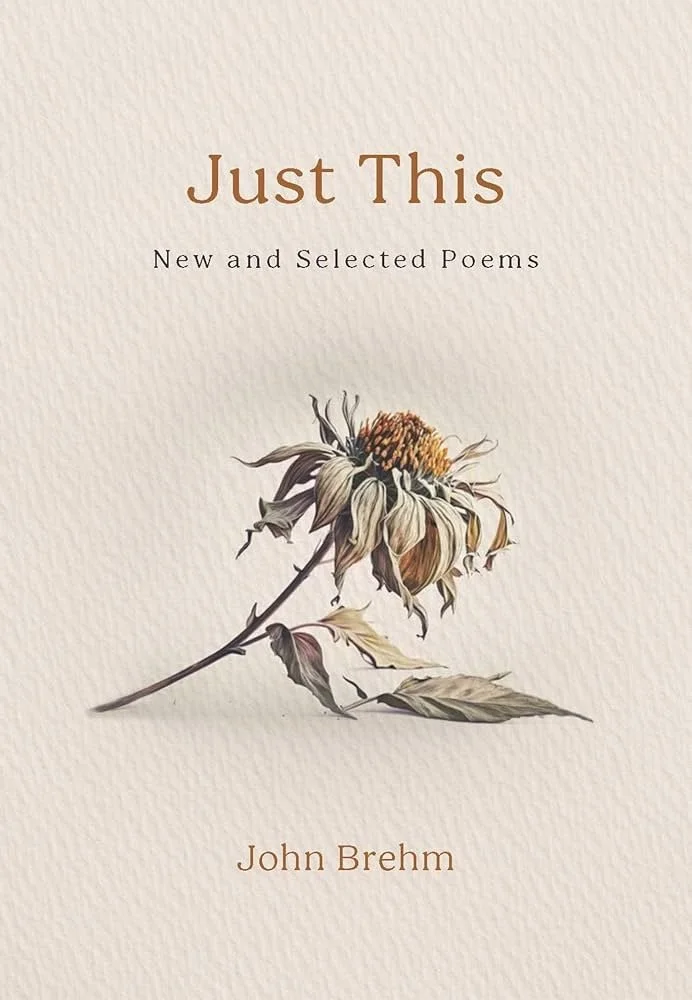
Just This, New and Selected Poems, by John Brehm. Wisdom Publications, 2026. 249 pp. $16.95 (paperback).
Review by Rick Larios
The first poem in Just This is a recent haiku by John Brehm, titled “Oncology Waiting Room.” Here it is:
Into a vase of wilted purple roses
the receptionist drops
an aspirin.
It is a perfect haiku, immediately available and present, but also humane and mysterious. Above all, it is a love song to impermanence. A wry homage, via the title and the roses, to our impermanence. It witnesses and exhibits compassion, with a trace of irony. And, in effect, it introduces the second poem, “Visitation with the Radiologist,” which begins:
“It’s not a good disease to have,” my doctor says.
I admire his grim honesty, I admire it
greatly. “Indolent but it usually does progress.”
Which sounds about right for me.
Two years of misdiagnosed torment
and now this. I ask him about suicide.
The whole poem is a jolt. The doctor and patient discuss Death with Dignity. The doctor notes that the disease partially qualifies him, “because / it’s incurable, though I might not meet / the six-months-to-live criteria, / just the unbearable pain part.”
Grim honesty, indeed! The poem continues. The doctor says:
“But they might make an exception
if it’s a choice between bending the rules
and blowing your brains out.”
This is my doctor, telling the truth, filters off.
I slide down into it as into a warm bath.
I want to stay here forever, ask him every question.
Maybe death is speaking through him.
What’s it like on the other side? I want to ask.
Once you’re dead, do you stop worrying
about what people think of you?
Are you allowed to intervene in the affairs
of the living, offer invisible advice now and then,
a nudge on the arm? How shall I live
with the time I have left is the real question.
I don’t ask it but let it blossom
into the room. This, this conversation,
this way of speaking, turns me
toward an answer.
Beneath the grim honesty is humanity, besieged yet dignified, aware but curious, afraid and defiant. Humor ducks in (“do you stop worrying / about what people think of you?”) and out but “the real question” remains unasked. For what it’s worth, I am with Brehm on this, having survived a heart attack and stroke and now living with an early-stage dementia diagnosis in my eighth decade. I want truth, grim or not. I want the opportunity to ask blunt questions and receive blunt answers. I want to cry, to joke, to live out my days as I lived them—to the best of my ability, or to make other choices.
***
Brehm is a poet, a teacher, a Buddhist, a husband, a nature lover of both wild and urban landscapes, a mensch, and, as he titled one of his earlier collections, no day at the beach. But who is? What matters is that he is both a fine poet and an honest navigator of life’s journey.
His revelation of fatal illness is reflective of his Buddhist and poetic practice, but it’s only occasionally a direct part of the new poems in Just This. There’s a poem about side effects for an unnamed medication: “Contact your doctor right away if you notice / a subtle increase in your receptivity / to gravity … or feel you have entered / what Gabriel García Marquez called / the endless Sunday afternoons of death.” But there are also other poems that capture moments away from death’s shadow, like “What He Looks Like,” which briefly depicts a conversation between two young siblings in as true and lasting an image as, say, a red wheel barrow in the rain. You will see and recognize the scene, the siblings, the moment.
Other poems are about meditations, to-do lists, thoughts on tombstone inscriptions, a poetic essay on pain and suffering, and a poem about nothing—a gently, wry poem describing insomnia:
The only thing happening
this early hour is nothing:
people sleeping, the weight
of their unconsciousness
darkening the air, loading
the clouds with dreamstuff
Brehm lists some of the early-hour nothings: “a crow, barely visible,” “a stack of books,” one of which is set “tentlike” atop the stack in a mistreatment of books that is taboo to his father-in-law. He also recalls Steve Sanfield’s haiku “long after / the call to prayer / the bell rope swaying.” Whether the prayers are meant to be answered or not is moot, or, maybe, the only answers are in the swaying of the rope, the echo of the asking, a proof of presence, like the dropping of an aspirin in the vase of wilted roses. We want more, of course, but wanting is at best a distraction.
Brehm concludes his ode to insomnia:
Warmth and light are what
I want from poems, quiet
from morning, sound advice
from a father-in-law, even if
I don’t follow it.
One imagines that the poet’s next move is to pick up the tented book, silently apologizing to his father-in-law, to read a little more in the early morning light and if, after a while, feeling sleep’s advances, closing the book and putting it flat atop the pile, shutting his eyes to rest, if not sleep.
There are additional poems that indirectly or directly reference his looming mortality—as the insomnia poem may well do. In “Update,” he presents himself as a dead tree, wryly listing his losses, lamenting his invisibility (“Birds fly right by me”). In another poem called “Prayer” he has a couple of longings he wants manifested: one, a nostalgia-driven belief “that the universe / is a friendly place, love // the only reality” and the other a request “to see and say something / beautiful, something that would / redeem this suffering…” In mock testiness he concludes the prayer, “If that is not too much to ask.”
***
In the second section of new poems in Just This, Brehm mines the Japanese short poem tradition of haiku and senryu. It contains twenty-three short poems. Among the haiku: “sunlit path / first the shadow falls / then the leaf” and “they take turns / raindrops / falling from the eaves.” Haiku is a form that lives and breathes impermanence. It doesn’t need a terminal diagnosis to become the subject. It just is, it’s always there. But the specificity of each haiku makes it immediate and both personal and detached at the same time: “summer storm / the same thunder / I heard as a child.”
Most of the twenty-three short poems are senryu, a form that focuses on human folly and imperfection, sometimes with a humorous twist. How ridiculous we are, how human and connected to all things. This form may have been invented for Brehm: “now that I’m old and sick / everyone saying / how good I look” and “tip of the tongue / I can almost taste / the wayward word” and “tomorrow / I’m going to start / living in the present.”
Brehm, in fact, has a genius for finding his way to humane understanding and acceptance; two of my favorites of his senryu are: “writer’s block— / the cat rests her chin / on my right hand” and “long-winded / and short-sighted / the poet goes on and on.” Two things to consider, one about each: first, who would ask a resting cat to move her chin, as if we had anything more important to do? Second, if Brehm could be two places at once he would be the poet sitting in the audience thinking this thought and the poet before the mic, starting an anecdote and turning the page to read just one more poem.
The first two poems of Just This made for a provocative start. How could they not—someone looking at a claustrophobically encroaching death sentence, filled with pain? It’s a heavy foreshadowing as you get set to read a volume of poems that is mostly comprised of work written long before that news. The impulse is to read forward in time, not backward—what’s next, not what happened before. Then you remind yourself that we are all under that sentence, as Brehm well knows. In any event, this isn’t a foreshadowing but a compelling reminder of the human condition, the condition of all living things. I recommend going forward into his past work without hesitation, and then rounding back to the new poems again when you finish the older ones. They’ll hit differently for a variety of reasons, mostly because you know more about the poet, his perspectives, his life, his concerns and choices. But, also, because the continuity of life is often cyclical, never only linear. The earlier poems have love’s failures, life failures, love’s successes, beautiful moments, difficult moments, and, of course fear—of death and dying.
***
The selected poems in Just This are pulled from four previous collections, Sea of Faith (2004), Help Is on the Way (2012), the aforementioned No Day at the Beach (2020), and Dharma Talk (2023). None of these is out of tune or character with the new poems. The register might be less imminently dire but the mood is one of seeking answers, seeking balance with life’s choices, its withheld rewards, modest failures, modest victories and some big ones—love is found, and tragedy.
Brehm works in the broad, plainspoken American tradition of Walt Whitman, Robert Frost, William Carlos Williams, Langston Hughes, Mary Oliver, Lucille Clifton, Charles Simic, William Mathews, and Jane Hirshfield, among others. His humor reminds you a little of the humor in William Mathews’ poems, though it’s more directed at self, like Andrea Cohen’s poems, because of the wistful beauty and shifts from outrage or frustration to humble self-revelation. Brehm’s focus is on the personal world—work, love, family, home, health, everyday events: commuting, desires, relationships, the enthusiasm of dogs, encounters with strangers and with nature. He is an acute observer of the world around him and within him. He is a large presence in his poems, as Whitman was, but entirely of the ordinary moments of life, the Whitman of the hospital and bivouac campsite visits. Whitman the witness, not the demi-god elevating all to the Cosmos.
His style is conversational. As in the capture of his and his radiologist’s exchange, there are conversations sprinkled throughout—with his father, with a girlfriend, with the IRS, with colleagues, with students, with strangers, and, in “So Long,” with the personification of all his failures, who shake their fists at him from shore as he escapes from their clamoring, “We made you who you are,” they wail, as he sails away, knowing he hasn’t escaped. He shares concerns about the advantages of his chosen profession in “Of Love and Life Insurance: An Argument,” rebutting a call to pre-reform his ways, he says, “I guess an unsuccessful poet / isn’t as attractive as it used to be.” To the IRS to whom he owes back taxes, plus interest, and a fine, he bargains, willing to pay the back taxes and interest but perhaps having the fine forgiven. His case: I’m doing my best and “being a poet isn’t as lucrative / as you might imagine.” These are satires—about relationships but also about himself, his commitment to his calling, and its consequences, mixing self-mockery with unchanged commitment. “Change of Service” is a NYC subway experience that starts as a realistic disruption in normal service but evolves into a Kafkaesque joke, ending as it began with a change in service that leaves you no closer to your destination despite all the changes of passage, direction, and mode of transportation.
This conversational style can start in mundane moments and find its way via the discursive presentations of the moment into something else again. The poem called “Pompeii,” for example, begins
Standing on the subway, exhausted, dispirited
glancing over the exhausted, dispirited faces
of my fellow passengers, I read posters
for a new movie about Pompeii.
He notes the different tag lines of the posters, including one that poses this question: “How can you outrun an eruption faster than this train?” The poet’s exhausted, dispirited mood surrenders to the obvious joke.
Obviously the ad writer has never been
on this train, because this is a Q train,
and anybody who can’t outrun a Q train
must be on death’s doorstep anyway
It’s a joke and, as a regular rider of the Q train, I can confirm its underlying veracity. But as he follows the observation of being overtaken by the “boiling mudslide” into a realization that this is how time can sometimes feel, like being overrun by molten lava, something else comes to him:
And now we rise creaking
over the Manhattan Bridge, where
one can see through scratchy windows
the city skyline and the buildings that are
not there, where thousands tried
to breathe air on fire and failed,
tried to flee an avalanche of concrete
and falling bodies and failed.
If only they’d been asked to outrun something
as slow as this train that takes us home—
how easily they might have done it.
But that is not what they were asked to do.
From self-pity to sarcasm to reverent grief for 9/11’s casualties.
***
Then comes the second poem in this collection that stops you dead in your reading tracks—actually a sequence of poems under the umbrella title “To Make the Wound More Beautiful.” It ends the selection of poems from Help Is on the Way. It’s a brisk, startling, twenty-three-page poem about the poet and his nephew and mortality. First, Brehm introduces us to George, his nephew:
Inward, self-questioning, often unsure.
Often clearly miserable:
a kindred spirit, my nephew.
Readerly and melancholy.
The only other in my family
thus afflicted.
Succinct, sensitive, deft and mutually revealing—it’s an apt introduction. The two build a special relationship on visits by the nephew to New York City, via book exchanges, sharing jazz, art, neighborhood tours, restaurants, and whatever form of education fake threats represent. “If I catch you / staring at the sidewalk / I’m sending you home.” George takes to heart this command to observe, to pay attention, discovering beauty, culture, diversity and universality in human nature. He “started talking to everyone— / jazz players after a set, / flea-market vendors, / fellow travelers on the subway.” George outdoes his mentor—we often teach or coach our charges to follow our lead up to a point, but then also to go further than we ourselves dared—becoming curious, compassionate, comfortable in his own skin, brilliant, with an open mind and heart.
Then, on the poem’s third page, the story takes a turn. George is an adult, living in Japan. His father calls Brehm; his nephew is grievously ill. Death moves beyond an idea into a staggering and immediate reality, for George and his family. George needs a liver transplant. Brehm is the most viable donor. He handles the narrative with restraint, honesty, and compassion for all.
Brehm immediately agrees to be the donor. Both poet and nephew are at risk. He tells us twice that his first thought is “This is going to happen and I am going to die.” Before the surgery he tells George’s father, his brother, “That if George lives / and I die, I can live with that.” The poem is about love, family, and sacrifice, and should be read in full not in a review summary
Brehm’s wisdom, like his humor and his poetic voice, can be blunt or gentle, and sometimes both at the same time. It gives him capacity to address a range of subjects in a diversity of circumstances with grace and compassion. He is a curator of life’s ordinary beauty and our extraordinary resilience in a world too often brutal and callously unresponsive to hardship, struggle, and tragedy. There is a moving elegy for his father, “Swifts;” a pair of beautiful love poems for his wife, “Here, An Epithalamion” and “Over the Moon,” and, a dreamy Taoist poem-meditation, “Sleeping in the Wind,” about “How beautiful it will be to be / a wind without a body, / a swift unfolding curvature / of air, slightly lighter, / or heavier, than standing air…” The poem is one sentence long, a literal question with no answer. Which makes it a rhetorical question, a wish.
we watch from the cheap seats
of ourselves, the hands,
crippling up, in constant pain,
the back proving the foolishness
of walking upright again
and again, the trees still calling us
to live up there, safely out
of sight, at ease above the earth,
harmless and free from these
imperfect accommodations,
caressed by and sleeping in
the wind we will become?
“Sleeping in the Wind” is a beautiful poem. And that phrase and that line break—“from the cheap seats / of ourselves”—a perfect colloquialism lifting such a beautiful evocation of life beyond body.
There are so many more poems to discuss, but I’ll stop here. I encourage you to seek this wonderful collection out and invite you to look forward to reading “Reprieve,” “Supplication at the River,” “Sotto Voce,” “Autumn,” “Flight Path,” “Morning, East Wallingford,” “Dudley Ball,” “Walk the Talk,” the haiku in Dharma Talk, and all the poems mentioned or discussed here. Brehm is not just a conversational poet, a master of vernacular, but one who writes in conversation with the reader. His poems are in response to our shared humanity. You will find yourself in its pages, recognized and recognizing, and yet still being surprised. You will be in very good company, as if the reading was done sitting across a table, sharing a coffee, with this fine, brilliantly compassionate poet.
Reviewer Rick Larios, a retired educator and editor, lives in Brooklyn with his wife, retired labor journalist and photographer, Cara Metz.